
Building Frequency Temperature Superposition Master Curves
Introduction High Frequency Needs Nowadays, a lot of materials are submitted to repetitive mechanical force or solicitation. For example: some joint polymer part …
Most conventional DMAs are limited to a few tens of hertz, so high-frequency properties have to be extrapolated with WLF calculations. VHF104 measures viscoelastic properties directly, from 100 Hz up to 10 kHz.
Maximum frequency, measured directly
Typical high-frequency sweep
Reach with WLF extrapolation
Strain range
With a conventional DMA, reaching high-frequency properties means running low-frequency sweeps over many temperature stages for several hours, then applying WLF calculations. VHF104 does it with a direct test in a few minutes.
That makes it ideal for industrial labs that need to analyze large numbers of material formulations quickly.
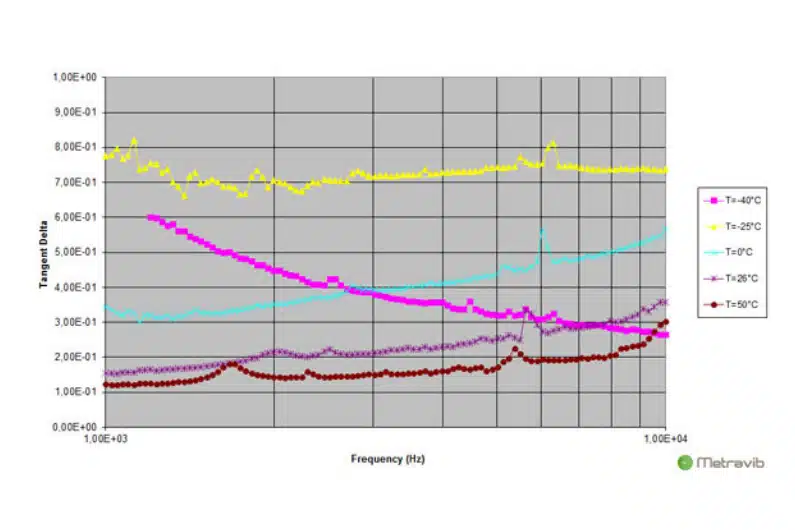
VHF104 results cross-check very well with conventional DMA. In a comparison with a Metravib DMA+150, master curves built by extrapolation closely matched direct VHF104 measurements, which took 5 minutes instead of a couple of hours.
Frequency sweeps from 5 Hz to 200 Hz over 20 temperature stages, then WLF extrapolation with the Dyna+ FTS function to build master curves from 0.1 Hz to 5 kHz.
Direct measurement across the high-frequency range in about 5 minutes, with very good agreement with the extrapolated master curves.
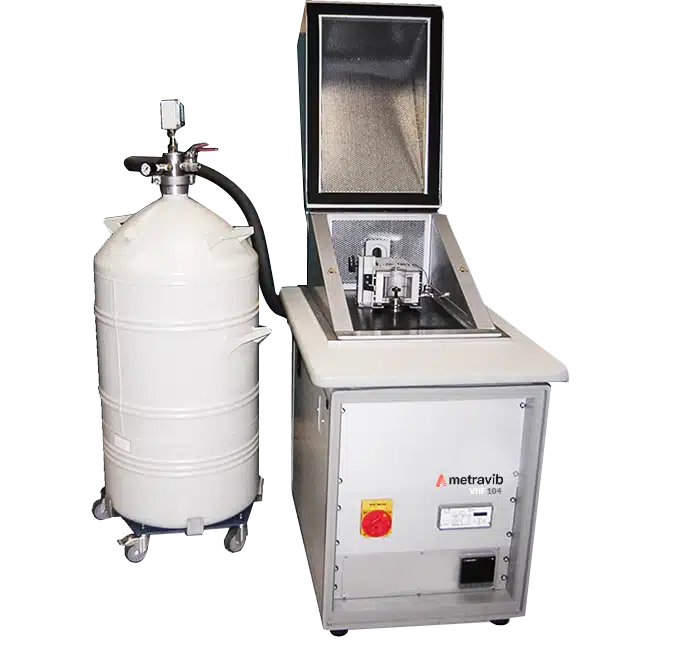
VHF104 is a single mechanical cabinet, configured with the options your testing needs.
A test frame with an electrodynamic shaker drives the high-frequency excitation.
Power amplifier and electronic interface built into the cabinet.
Tension-compression holder standard, with a shear holder available as an option.
Thermal chamber (ambient to 110 °C) or cryogenic source (−30 °C to ambient).
| Frequency: | Min: 100 Hz Max: 10 kHz |
| Temperature Range: | Option 1: Min: Ambient Max 110 °C Option 2: Min: -30 °C Max: Ambient |
| Strain Range: | 10E-6 up to 30%* Note: usable frequency range may depends on specimen geometry & material’s nature |
| Modes: | Tension-compression Shear Short test duration (about 5 minutes) |
| Composition: | VHF 104 consists in a mechanical cabinet including: • Test frame including electrodynamic shaker • Power amplifier • Electronic interface • Tension-compression specimen-holder • Shear specimen-holder (option) • Thermal chamber (option) • Cryogenic source (option) |
Introduction High Frequency Needs Nowadays, a lot of materials are submitted to repetitive mechanical force or solicitation. For example: some joint polymer part …
Introduction Dynamic Mechanical Analysis (DMA) is a well-established technique for characterizing the viscoelastic (mechanical) properties of materials and is increasingly used in biomedical …
Introduction To understand the viscoelastic behavior of a material, Dynamic Mechanical Analysis (DMA) is one of the most useful characterization techniques. It helps …
Introduction During polymer manufacturing, molecules often do not have sufficient time to move into the positions or conformations that correspond to the processing …
Introduction Creep is one of the most fundamental and dominant analytical tools used to study material behavior. These measurements help characterize the response …
Introduction Errors in the conception of composite materials can lead to disappointing mechanical properties. DMA is a powerful tool for determining the properties …
The latest articles, white papers and application notes on dynamic mechanical analysis.
Introduction High Frequency Needs Nowadays, a lot of materials are submitted to repetitive mechanical force or solicitation. For example: some joint polymer part …
Introduction Dynamic Mechanical Analysis (DMA) is a well-established technique for characterizing the viscoelastic (mechanical) properties of materials and is increasingly used in biomedical …
Introduction To understand the viscoelastic behavior of a material, Dynamic Mechanical Analysis (DMA) is one of the most useful characterization techniques. It helps …
Introduction During polymer manufacturing, molecules often do not have sufficient time to move into the positions or conformations that correspond to the processing …
DMA25 and DMA50: flexible, cost-effective desktop thermomechanical testing.
DMA+300, DMA+1000 and DMA+2000, with dynamic forces up to 2000 N.
Automated specimen handling to run DMA+ test campaigns around the clock.
Get a quote today and discover how Alpha and Metravib’s dynamic testing instruments, dedicated support and specialized expertise can advance your materials testing.