
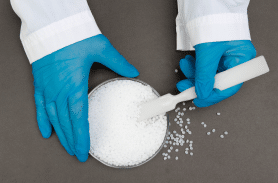
In most labs, developing a full thermal and rheological profile for polypropylene (PP) samples means coordinating between three instruments, multiple operators, and a multi-day test queue. What if you could measure all three – physical properties, Tg/Tm, and dynamic viscosity – in a single, closed-cavity test?
- Premier™ ESR with Sub-Zero™ Technology delivers Tg, Tm and a full frequency-sweep viscosity curve from the same pellet in less than 30 minutes
- Tg shifted from 8.36 °C (PP HP) to –4.75 °C (PP BcP) and –14.68 °C (PP RcP); DSC reported ~ −35 °C for all
- Zero-shear viscosity for PP HP matched six-hour low-shear benchmarks in roughly 15 minutes
- No liquid nitrogen, no reloading samples, no handoffs between departments
One tool measures dynamic viscosity, another registers thermal transitions such as glass transition and melt point temperature (Tg/Tm), and a third logs physical properties. Each tool has its own prep, calibration, and quirks.
Alpha Technologies’ Premier™ ESR with Sub-Zero™ Technology condenses that workflow. A single closed-cavity run delivers Tg, Tm, and a full frequency-sweep viscosity curve from the same pellet in less than 30 minutes.
Time-Consuming and Fragmented
Here’s what a typical characterization sequence looks like:
Physical properties via DMA
Time-intensive and typically takes 1–2 days to schedule and run.
Tg/Tm via DSC
Provides heat-flow data but lacks precision in capturing subtle mechanical shifts, especially in filled or blended PP grades.
Viscosity via rotational rheometer
Limited to low shear rates and subject to edge fracture.
Multiply that cadence across dozens of blends and the hands-on time, cost, and data-management effort escalate quickly.
One Instrument. One Run. Under 30 Minutes.
In our recent study, we used the ESR with Sub-Zero to evaluate three types of polypropylene without liquid nitrogen or special sample prep: PP Homopolymer (PP HP), PP Block Copolymer (PP BcP) and PP Random Copolymer (PP RcP). A single test sequence produced:
Glass transition temperature (Tg)
From the peak in loss modulus (G″).
Melting point (Tm)
Confirmed by concurrent pressure rate drops and die gap traces.
Shear viscosity
Captured through a frequency sweep modeled with the Cross equation.
No liquid nitrogen. No reloading samples. No handoffs between departments.
Here’s What We Measured
Compared to DSC (which reported all Tg values as ~ −35 °C), the ESR data revealed meaningful transitions and formulation differences that align with real-world mechanical performance. The rheometer resolved real grade-to-grade differences that DSC masked.
Tg by Sub-Zero rheometry (G″ peak)
PP Homopolymer
HP
PP Block Copolymer
BcP
PP Random Copolymer
RcP
DSC reported ~ −35 °C for all three grades.
Tg shifted from 8.36 °C in PP HP to –4.75 °C in PP BcP and –14.68 °C in PP RcP, while Tm ranged from 127.95 °C to 139.71 °C depending on copolymer architecture.
Zero-shear viscosity for PP HP, derived from two frequency sweeps, matched six-hour low-shear benchmarks in roughly 15 minutes.
Three decisive advantages
- Speed: Complete thermal and rheological profile in under 1 hour
- Sensitivity: Detects mechanical transitions that thermal-only tools often miss
- Efficiency: Consolidates equipment, fewer samples to prep, calibrate, and archive; streamlined data management
For compounders, QA labs, and R&D teams working with polypropylene, whether you’re qualifying a new copolymer, validating recycled content, or benchmarking suppliers, capturing Tg, Tm, and viscosity in one pass streamlines decision-making and reduces risk.
See the Full Data for Yourself
Download “Pinpointing Polypropylene Glass Transition Temperatures Using Sub-Zero Rheology” for detailed methods, side-by-side DSC vs. ESR comparisons, and implementation guidance.