Pinpointing Polypropylene Glass Transition Temperatures Using Sub-Zero Rheology
More precise than DSC. Faster than DMA.
Learn how a sub-zero rheology approach delivers more precise Tg measurements than traditional DSC, and faster readings than DMA, in minutes.
In this white paper, you’ll learn:
Why Plastics' Tg matters for sub-ambient performance
Where DSC and DMA fall short for routine QC
How an encapsulated sub-zero rheometer detects Tg shifts as small as 0.5 °C
Full validation data and comparative performance insights
Get the white paper
Download the polypropylene glass-transition white paper.
+/-0.5 °C
Tg sensitivity between grades
Minutes
instead of hours or days
No liquid N₂
sub-ambient testing without cryogenics
The Challenge
Why you need a more accurate way to measure PP Tg
Polypropylene’s versatility comes from its low cost and ease of processing, but its real-world performance at sub-ambient temperatures depends on its glass transition temperature (Tg), which varies subtly between grades.
Traditional Tg measurements with DSC or DMA can be slow, less accurate in the case of DSC, and impractical for routine QC. A fully encapsulated sub-zero rheometer reduces slippage and variance, delivering highly repeatable, rapid measurements free from human error.
Rapid, High-Precision Tg Profiling
Tg insights in minutes, not hours or days
A next-generation sub-zero rheometry workflow helps you make confident material choices faster.
Test faster
Replace slow, multi-step DSC or DMA routines with a single test, so R&D and QC teams can focus on innovation instead of backlogs.
Precision without cryogenics
Distinguish Tg shifts as small as 0.5 °C without liquid nitrogen.
3-in-1 profiling
Capture rheological Tg and Tm plus mechanical damping in one sub-zero test on pellets, with no sample preparation.
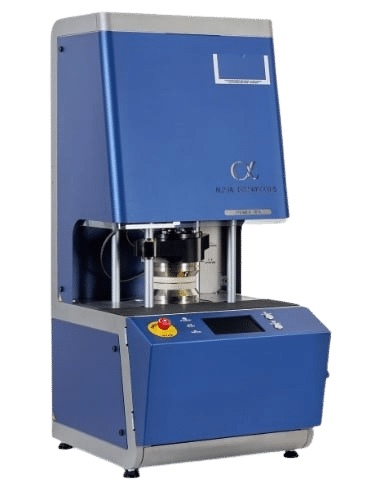
About the Premier ESR with Sub-Zero™ Technology
Precise Tg measurements below freezing
Our encapsulated sub-zero rheometer applies oscillatory shear to polypropylene samples below freezing, delivering precise Tg measurements in minutes and replacing time-consuming DSC and DMA routines.
Oscillatory shear testing to sub-ambient temperatures without liquid nitrogen
Detects grade-to-grade Tg shifts with 0.5 °C sensitivity
Automated, production-ready workflow for R&D and QC
About the Study
Developed by Alpha’s application experts
Unal Yilmazoglu, Senior Scientist and Global Application Team Leader, and Richard Hanzlik, Market Development Manager, developed this study to find a definitive way to measure Tg accurately and efficiently across polypropylene grades. The study used the Premier ESR®, which complies with ASTM D7750.