
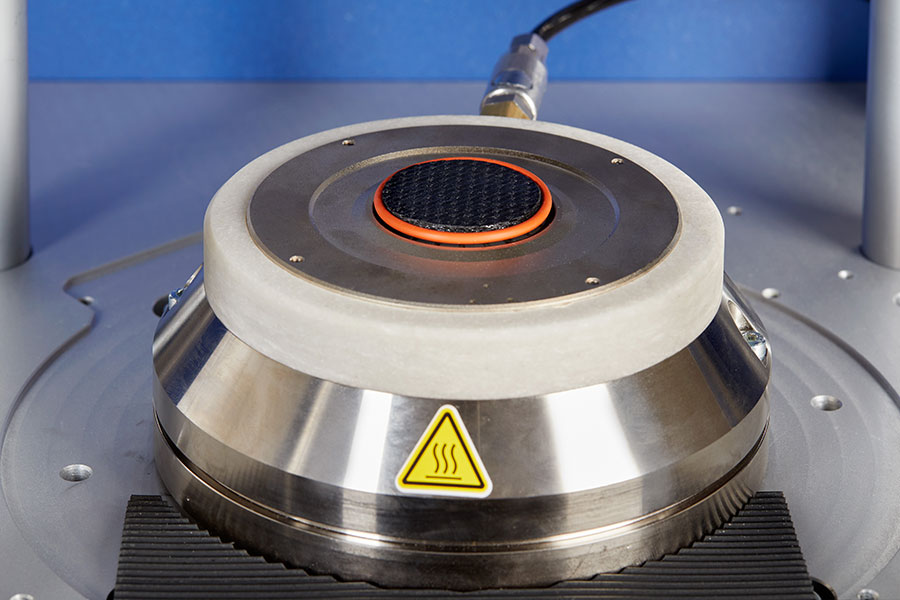
In this article we’ll examine cure temperature and its impact on the thermal and dimensional stability of prepreg materials.
- Raising cure temperature lowers resin viscosity for better flow and fiber wetting
- Too high a temperature causes non-uniform resin, thermal stresses, cracking, voids and warping
- Too low a temperature causes incomplete or non-uniform cure; too high causes over-cure
- The Premier ESR tracks G′, G″ and tan δ through the cure
Alpha Technologies evaluated the influence of processing parameters on the rheological behavior and mechanical properties of prepreg composites using an Encapsulated Sample Rheometer (ESR). The parameters included cure temperature, ramp rate and out-time.
This is the first in a three-article series exploring the results of this study and the role of Alpha’s Premier ESR® in advancing a company’s process optimization goals for their prepreg materials. To learn more about the other key processing parameters we studied, download the full study.
Key Rheological Parameters for Prepreg Curing
In the context of temperature and prepreg curing, there are three key rheological parameters to consider:
Storage modulus (G′)
Measures the stiffness or solidity of a prepreg material. The value of G′ designates the material’s capacity to store and recover energy elastically when deformed. The higher the G′ value, the more solid or elastic the material.
Loss modulus (G″)
Measures the prepreg material’s viscosity or resistance to flow. G″ refers to the amount of energy that dissipates from the material as heat during deformation. Higher G″ values indicate greater energy loss and more pronounced viscous behavior.
Tan δ
The ratio of G″ to G′, key to understanding the balance between elastic and viscous properties, the degree of cure, and resin flow. Flowability matters most early in processing, when the material must conform to the tool. A higher tan δ suggests greater flowability.
How Cure Temperature Affects Prepreg Properties
Cure temperature has a significant impact on the thermal and dimensional stability of prepreg materials. Strategically increasing cure temperature reduces the viscosity of the resin, which leads to better flow and more thorough wetting of the fibers. This can improve the dimensional stability of the final prepreg material.
Balance, however, is critical. If the cure temperature is too high, there can be a number of unintended consequences:
Non-uniform resin
Excess reduction in resin viscosity results in non-uniform resin distribution, with a negative impact on mechanical properties and storage modulus.
Thermal stresses
Increased thermal stresses may affect the termination of the curing reaction and lead to cracking and void formation over time.
Warping and distortion
Caused by different thermal expansion rates of the fibers and the matrix.
Issues With Improper Temperature Control
A number of prepreg material production issues can be credited to a cure temperature outside of the optimal range for a given material.
Incomplete cure
The hardening of a prepreg material is the result of a chemical reaction during curing. If the cure temperature is too low, this reaction may not occur, and the final product may be soft, sticky, or tacky.
Non-uniform cure
If the cure temperature is too low, the product may be removed from the oven before thicker areas have had adequate time to cure, resulting in a non-uniform final product.
Excessive cure
Over-cured resin can be porous and brittle, due to the degradation of its mechanical properties. This usually occurs when the cure temperature is too high.
Troubleshooting Prepreg Failures with the ESR
For a detailed study of common prepreg cure failure modes and how to troubleshoot issues with rheological measurements, download our white paper.