
Fillers can serve a wide range of functions within a polymer compound. Manufacturers can also strategically leverage them to improve the lifecycle of their product, and bound rubber content is the key to predicting that performance.
- Bound rubber, the microscopic interaction between fillers and polymer chains, creates a rigid 3D network throughout a compound
- Too much bound rubber raises heat generation and aging; too little reduces stiffness, tear strength and abrasion resistance
- The Premier RPA quantifies bound rubber faster and far less messily than solvent extraction
- In one compound, cutting carbon black from 70 to 60 phr reduced heat buildup without compromising wet traction or rolling resistance
Bound Rubber and Product Lifecycle
A filler may improve performance characteristics, such as strength or durability, or processing behavior, such as flow. Additionally, manufacturers may use fillers to reduce production costs.
For example, the addition of certain classes of carbon black to conveyor belt compounds can increase the compound’s bound rubber content. Bound rubber, the microscopic interactions between fillers and polymer chains, creates a rigid 3D network throughout a rubber compound.
Understanding of bound rubber content is key to predicting product performance and lifecycle. However, precision is critical. Inaccurate assessments of bound rubber content can lead to suboptimal rubber formulations and, consequently, product performance issues, including:
Premature degradation
Too much bound rubber content can result in excessive filler-rubber interactions, which increases heat generation. Excess heat accelerates thermal aging and product wear, which can reduce the lifespan of the product or material.
Unpredictable failures
Inadequate bound rubber content reduces the stiffness, tear strength, and abrasion resistance of the material, leaving the product vulnerable to damage and premature failure in certain service environments.
Striking the appropriate balance between competing performance characteristics requires optimizing bound rubber content, and that level of optimization may only exist within a very slim margin. Getting it right is critical to delivering top-quality products.
Wasted time and resources are another possible consequence of inaccurate bound rubber content assessments. Multiple rounds of trial-and-error can draw out the research and development cycle, resulting in increased costs and delayed go-to-market timelines.
Accuracy and Efficiency in Bound Rubber Quantification
The most convenient method for quantifying bound rubber content in a polymer compound is a rubber process analyzer (RPA). An RPA is faster and far less messy than solvent extraction and offers deeper insight into the implications of bound rubber content with regard to product performance and lifecycle.
Alpha Technologies recently conducted a study of the relationship between bound rubber content and rubber product lifecycle prediction, using data from the Premier RPA. The study uncovered several key correlations offering deep insight into product performance.
Dynamic properties
The Premier RPA infers the role of bound rubber in filler-rubber networks by measuring storage modulus and hysteresis loss. High-structure carbon black is correlated with elevated storage modulus, indicating strong filler-rubber bonds.
Strain sweeps
Strain sweeps reveal how bound rubber stabilizes the filler networks within a compound, which reduces both hysteresis loss and the Payne effect.
Temperature sweeps
Temperature sweeps correlate tan δ, a measurement of heat dissipation and elastic deformation during storage, with temperature-dependent behavior. Certain classes of carbon black fillers maintain low tan δ at high temperatures, which reduces premature, heat-induced aging in tires.
Hysteresis curves
Hysteresis curves quantify dissipated energy, which has a linear correlation with heat buildup. This allows for more precise prediction of thermal degradation, which is critical for understanding product lifecycle.
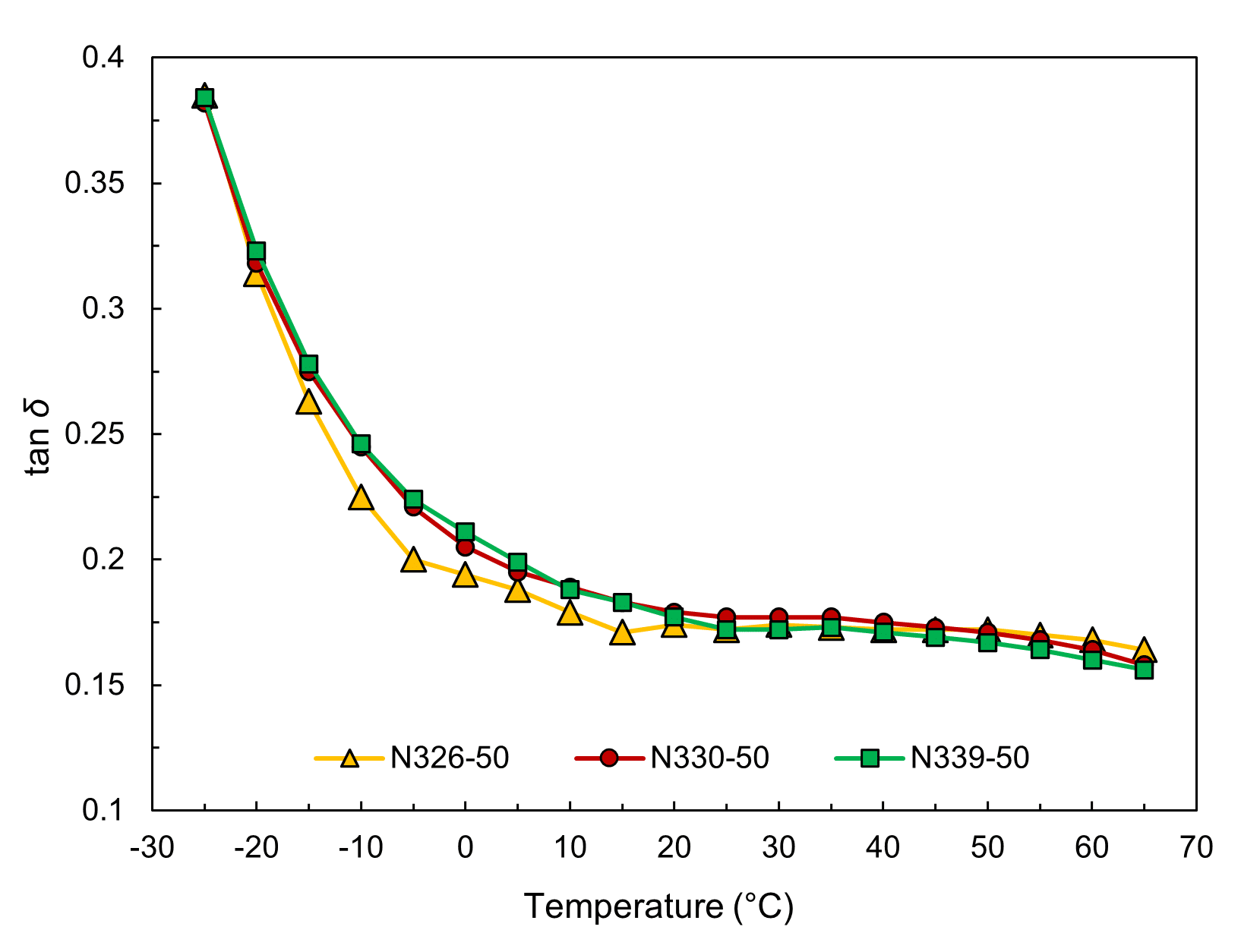
tan δ versus temperature for compounds filled with N326, N330 and N339 carbon black
This deeper insight into bound rubber content gives manufacturers the data they need to make strategic decisions about performance trade-offs. Alpha Technologies discovered that reducing carbon black loading from 70 phr to 60 phr in one particular compound resulted in reduced heat buildup without compromising the compound’s wet traction and rolling resistance.
Product Lifecycle Optimization With the Premier RPA
Leveraging the Premier RPA as a bound rubber qualification tool can yield considerable advantages in a wide range of industries, giving manufacturers the data they need to extend the lifecycle of their products by optimizing bound rubber content. Specific examples include:
Tires
Optimizing bound rubber content in tire tread compounds can reduce tread wear, extending the life of the tire.
Automotive components
By tuning bound rubber levels, manufacturers can create engine mounts with stable dynamic properties that withstand vibration without cracking, and reduce heat-inducing hardening in seals and gaskets so they maintain flexibility over time.
Industrial rubber components
Conveyor belt compounds made with moderate quantities of bound rubber balance abrasion resistance and heat generation. Optimizing vibration dampers prevents filler network breakdown, ensuring consistent damping over millions of cycles.
Making the Most of Bound Rubber
These examples come from a comprehensive bound rubber study conducted by Alpha Technologies with the Premier RPA. Get the full data behind these observations.