
The application of Fourier Transformation to the shear stress signal is a very sensitive technique to optimize the mixing process of filled rubber compounds. Here, real LAOS experiments track filler dispersion along the mixing line.
- A highly silica-filled SBR/BR tread compound was sampled at each mixing stage
- LAOS strain sweeps from ±30% to ±1000% at 100 °C and 0.5 Hz on the Premier RPA
- The I3/1 local maximum shifts right and fades as the filler network is destroyed
- Use it for R&D on new formulations and for QC on the compound production line
The application of Fourier Transformation to the shear stress signal is not only a powerful tool to quantify the level of long chain branching in polymers but also a very sensitive technique to optimize the mixing process of filled rubber compounds. This technique is called FT-Rheology.
FT-Rheology via Large Amplitude Oscillatory Shear (LAOS) reveals more information about the filler-filler / filler-polymer interactions than the traditional Payne effect approach, and provides a check at the end of the mixing process to determine if the full dispersion of the filler in the rubber matrix has been achieved.
This approach was developed by Prof. Jean L. Leblanc. The description was presented in Part 1 of this series. (See…we said you should read it first!)
Putting Theory Into Action
To validate the approach presented by Leblanc, we performed tests using several filled rubber compounds – including not only carbon black compounds but also silica rubber compounds. Experiments were run on Alpha Technologies’ Premier™ RPAs using FT-Rheology via LAOS.
To confirm the predictive ability of the LAOS technique to evaluate the filler dispersion, we characterized a highly silica filled SBR/BR compound for tire application with the Premier RPA. The silica tread rubber compound was prepared with a suitable silica-silane reinforcing system and mixed on an internal mixer characterized by intermeshing rotors and an automatic adjustable rotor speed system, performing a two-mixing stage process.
Lab technicians took samples from each stage at different mixing times – for example, at the beginning of the first mixing step (after 1 min.) and at the end of this stage – to determine if the full dispersion of the filler in the rubber matrix has been achieved, by the end of the mixing process.
We performed a LAOS test on all samples taken from the mixer at different times as strain sweep subtests from ±30.0% to ±1000% strain at 100 °C and 0.5 Hz. By plotting the third relative torque harmonic versus strain for each compound sample, we were able to track the progress of the filler dispersion and the silanization reaction along the mixing line, see Figure 1.
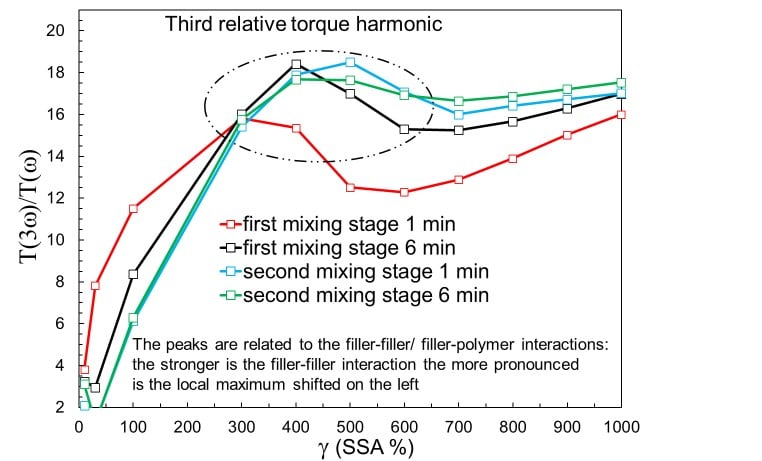
Figure 1. Third relative torque harmonic versus strain for samples taken along the mixing line
Take a Closer Look
At the beginning of the mixing, after 1 min., the non-linear response is dominated by filler-filler interactions and the local maximum is shifted to the left. After that, as the mixing proceeds, the local maximum is shifted to the right. The more the filler network is destroyed the less pronounced is the local maximum. Probably by further prolonging the mixing time, with an additional mixing stage, it would have been possible to achieve the full dispersion of the filler in the rubber matrix and no maximum would have been observed.
This confirms the high sensitivity of the LAOS technique to evaluate the filler dispersion and its potential as powerful tool to optimize the mixing process.
As noted, we conducted identical tests using different compound formulations to further validate our results. These experiments yielded data consistent with the results we highlight here.
In Summary
When tests are performed on a Premier RPA, FT-Rheology via LAOS provides an alternative method to optimize the mixing process of filled rubber compounds.
The relative third torque harmonic vs. strain discloses information about the filler-polymer interactions and allows us to track the progress of the filler dispersion along the mixing line. This test method can be used to optimize the mixing process of uncured filled rubber compounds. What’s more, it can be applied to both R&D assessments of new compound formulations, as well as for QC in the compound production line.
Part 3: Using LAOS to quantify long chain branching
How LAOS distinguishes polymer topologies and predicts processability.
- Leblanc, J.L.; Rubber Chemistry and Technology, 78, 54-75 (2005)
- Leblanc J.L., Chapelle C. de la; Rubber Chemistry and Technology, 76, 287 (2003)
- Leblanc J.L.; Rubber Chemistry and Technology, 86, 261–285 (2013)
- Leblanc J.L.; Journal of Applied Polymer Science 109, 1271 (2008)
- Nijman, G., Leblanc, J.L.; Journal of Applied Polymer Science 112, 942 (2009)
- Leblanc, J.L., Nijman, G.; Journal of Applied Polymer Science 112, 1128 (2009)
- Nijman, G.; GAK 68, 400 (2015)