
When seals lose their flexibility and ability to respond to a reaction force at low temperature, the change is physical. The compound must be formulated for optimum performance of the final product, while ensuring the correct V/E ratio is maintained.
- Seals in aerospace, oil & gas, food & dairy, automotive, pharmaceutical/medical and petrochemical applications must stay flexible in the cold
- Five standard tests assess low-temperature suitability: brittleness, retraction, stiffening, compression set and DMA
- DMA finds Tg at the tan δ peak of a temperature sweep
- Premier RPA + Sub-Zero measures processability, cure and cured dynamic properties in one test definition, cutting cycle time by about 35%
Seals are used in many critical applications including (but not limited to) aerospace, oil & gas, food & dairy, automobile, pharmaceutical / medical, and petrochemical. The following test methods can be used to assess the suitability of a compound in low temperature applications.
| Test | ASTM | ISO |
|---|---|---|
| 1. Brittleness test | D2137 | 812 |
| 2. Low temperature retraction test | D1329 | 2921 |
| 3. Low temperature stiffening test | D1053 | 1432 |
| 4. Low temperature compression set | D1229 | 815-2 |
| 5. Dynamic Mechanical Analysis | D5992 | 4664-1 |
Brittleness Test
This test uses a hammer of a specific mass, moving at a specified speed toward five cured rubber samples held by a grip. The samples and the grip are cooled to a specified low temperature. The hammer strikes the samples at the specified speed and continues moving past. The temperature at which fracture occurs in three of the five samples is said to be the brittle point of the rubber compound.
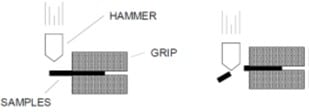
Figure 1. Brittleness test
Low Temperature Retraction Test
This test is conducted in the following sequence:
Elongate
Elongate the specimen.
Lock
Lock it in the elongated condition.
Freeze
Freeze it to a state of reduced elasticity.
Release and warm
Release the frozen specimen and allow it to retract freely while raising the temperature at a uniform rate.
Measure
Measure the length of the specimen at regular temperature intervals while it is retracting.
Compute
Compute the percentage retraction at these temperatures from the data obtained.
The temperatures corresponding to 10% and 70% retraction are designated as TR10 and TR70, respectively. The difference between TR10 and TR70 increases as the tendency to crystallize increases. TR70 correlates with low-temperature compression set. TR10 has been found to correlate with brittle point in vulcanizates based on polymers of similar type. In general, the retraction rate is believed to correlate with low-temperature flexibility of both crystallizable and non-crystallizable rubbers.
Low Temperature Stiffening Test
The test method is employed to determine the subnormal temperature stiffening of flexible polymers or fabrics coated with flexible polymers. Temperatures at which the low temperature modulus is a specified multiple or ratio of the modulus at room temperature are interpolated from the twist versus temperature curve. These specified ratios of low temperature modulus to room-temperature modulus are called relative moduli. These temperatures at the relative moduli encompass the transition region between the glassy and rubbery states of the material under testing.
Figure 2. Low temperature stiffening test
Low Temperature Compression Set
Rubber products, such as hydraulic seals on planes, submarine hatch gaskets, and hydraulic brake cups, may be exposed to varying temperature extremes. This test method provides a means of determining the extent to which recovery from compression at normal ambient temperatures is inhibited upon release of the compressive force during subsequent exposure at low temperatures.
At room temperature, a test specimen is compressed to 25% of its original thickness and exposed for a specified time at a specified low temperature. Upon release from compression, the specimen is allowed to recover while remaining at the test temperature. The residual deformation of the specimen is measured 10 s and 30 min after removal from the compressive device.
Dynamic Mechanical Analysis
DMA stands for Dynamic Mechanical Analysis. ASTM D5992 describes tests for determining glass transition temperature via DMRT and tan delta data. A frequency of oscillation is chosen, and the temperature is ramped up from a temperature well below Tg (i.e., the test uses temperature sweeps at a given frequency). The point at which tan delta reaches a maximum is said to be the material’s glass transition temperature. Once again, time and temperature are directly coupled via a specified heating rate, and again time and temperature effects are indistinguishable. ASTM D5992 also describes a method of determining Tg using results for E″, or loss modulus.
Low-temperature flexibility in one test
At low temperature, physical changes dominate over chemical changes in a rubber seal. Sufficient flexibility is needed to overcome initial drag so the elastomer can adjust its shape and keep the seal lip sealing. A cold and inflexible seal may result in damage to the seal lip, and in turn sealing action is lost.
Premier RPA + SZ is an effective DMA in torsional shear mode to provide data on V/E ratio and low temperature flexibility of seal rubber compounds. The instrument is designed to measure the mixed rubber compound processability, cure properties and cured dynamic properties in one test definition. It reduces the cycle time by approx. 35%.
Test low-temperature seal performance faster
Talk to our team about Sub-Zero testing for your seal compounds.