
A brief guide to bound rubber
Bound rubber is the result of interactions between polymer chains and fillers, such as carbon black or silica, on a microscopic level. It acts as a bridge between the rubber and the filler and creates a rigid, three-dimensional network throughout the compound.
- Bound rubber has a significant influence on heat build-up, rolling resistance, wet grip, abrasion resistance and flexibility
- Solvent extraction takes up to 72 hours, uses toxic toluene and is vulnerable to operator error
- Premier RPA tan δ at low strain correlates inversely with bound rubber content (R² = 0.9846)
- The RPA distinguishes the effects of filler loading and filler structure on bound rubber
Rubber, Filler and the Network Between Them
Rubber tends to adhere to the surface of filler aggregates dispersed through the compound, creating a strong physical bond between them. This bond, called bound rubber, acts as a bridge between the rubber and the filler and creates a rigid, three-dimensional network throughout the compound. A tightly bound layer and a loosely bound layer are usually both observed.
Until recently, bound rubber was not closely examined by the rubber industry. New studies by Alpha Technologies have revealed that bound rubber content has a significant influence on key performance characteristics of the final product. This includes:
Heat build-up
Heat build-up in products under cyclic loading.
Rolling resistance and wet grip
Rolling resistance and wet-skid resistance (wet grip) of tires.
Abrasion resistance
Abrasion resistance of industrial rubber products.
Flexibility
Flexibility in seals and gaskets.
Optimizing any of these parameters requires comparative quantification of bound rubber to ensure balance between interrelated performance characteristics. However, traditional methods for bound rubber testing are inefficient and inconvenient, which can be a barrier to leveraging the insights it may offer.
Methods for Quantifying Bound Rubber
Solvent extraction, perhaps the most popular way to test bound rubber, is a lengthy, messy, and fallible method. The process takes up to 72 hours and uses toxic solvents, such as toluene. Working with toluene, which is flammable and an irritant, requires extensive safety precautions. Additionally, solvent extraction is vulnerable to operator error. Incorrect measurements can lead to incorrect calculations throughout the development process and, ultimately, issues with long-term performance of the final product.
Alpha Technologies recently conducted a study to demonstrate the accuracy and reliability of the Premier RPA as a bound rubber quantification tool. Specifically, the study examined the correlation between bound rubber content from the traditional solvent extraction method and tan δ from strain sweep data points.
Bound Rubber Insights From the Premier RPA
Alpha discovered an inverse correlation between bound rubber content and tan δ measured at low strain. Strain sweeps revealed that, as bound rubber content increased, tan δ measured at low strain decreased. These results were strongly correlated to results from solvent extraction, demonstrating the high reliability of the Premier RPA as a bound rubber quantification tool.
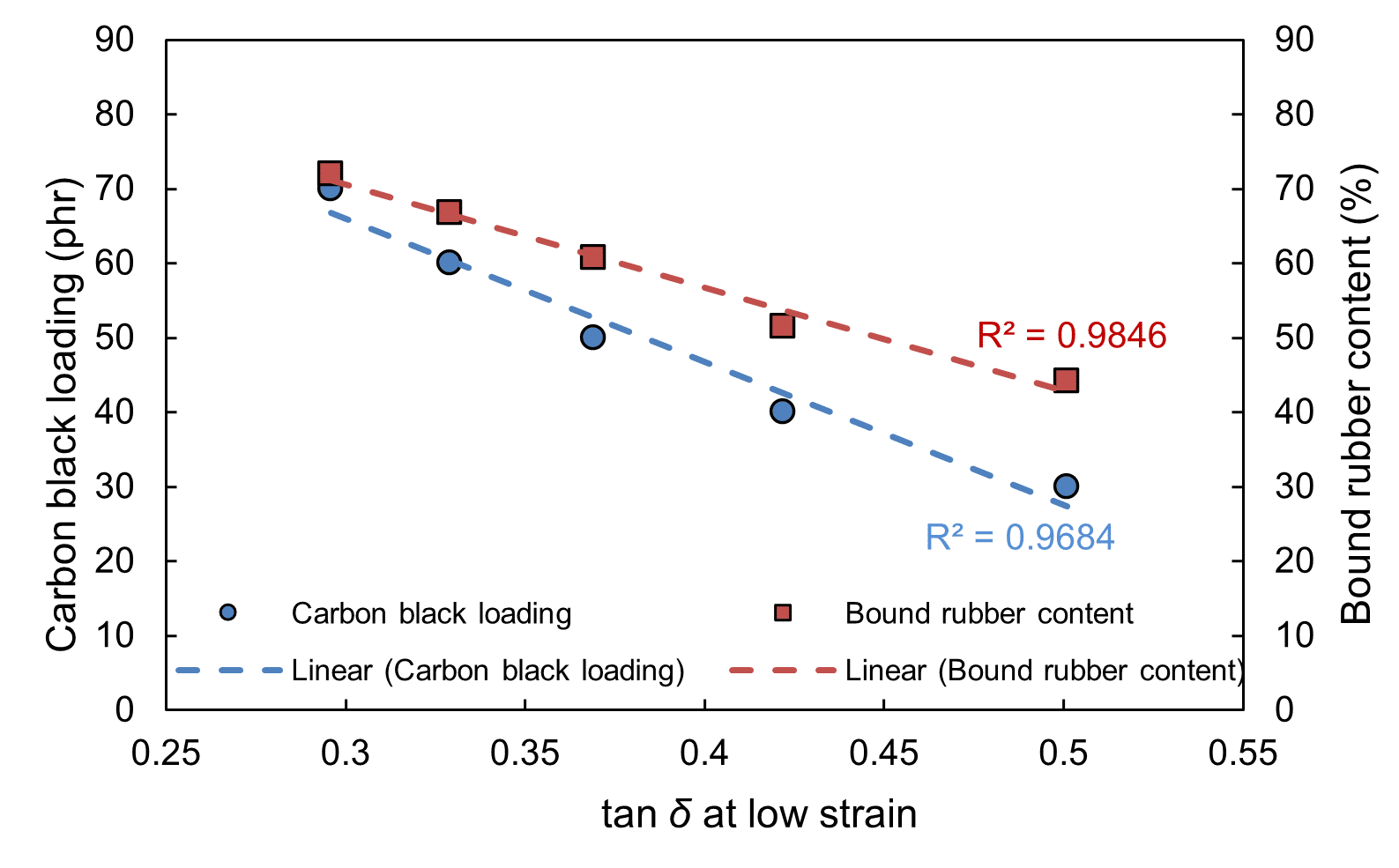
Carbon black loading and bound rubber content versus tan δ at low strain
The study also revealed that the RPA can distinguish between the effects of filler loading and filler structure on bound rubber content. Specifically, increased filler loading results in higher bound rubber content and lower tan δ, whereas high-structure fillers will increase bound rubber content.
What Bound Rubber Data Means for Your Products
These findings have several implications for rubber product manufacturing, especially tires. The study revealed that increased bound rubber content is correlated with increased modulus, hardness, tear strength, and abrasion resistance and decreased tensile strength and elongation. An additional finding is the relationship between rubber content and hysteresis loss. Higher bound rubber content is a strong predictor for increased hysteresis loss, which is valuable for anticipating and mitigating heat buildup.
Increases with bound rubber
Modulus, hardness, tear strength, abrasion resistance and hysteresis loss.
Decreases with bound rubber
Tensile strength and elongation.
In tires, increased bound rubber content translates to improved wet grip and increased rolling resistance. Tire manufacturers are motivated to find a balance between these two attributes, in order to optimize both wet traction and fuel economy—two desirable performance parameters among consumers. The Premier RPA gives manufacturers deeper insight into these parameters, their relationship to bound rubber content, and strategies for optimization.
Making the Most of Bound Rubber
Read more about bound rubber and see extensive data on Alpha’s findings.