
Heat generation is inevitable for any rubber product or material that experiences cyclic loading while in service, from tires to industrial belts. It is the product of friction between fillers and polymer chains. The technical term is hysteresis loss, quantified by measuring dissipated energy during deformation.
- Excess heat buildup shortens service life, reduces tire safety and raises rolling resistance
- Alpha Technologies’ study showed a strong correlation between heat generation and bound rubber content
- The Goodrich Flexometer is accurate but takes several hours; the Premier RPA is a faster alternative
- RPA dissipated energy tracked Flexometer temperature rise with R² = 0.9942
When Heat Becomes a Problem
Heat generation can be harmless below a certain threshold, but too much friction between polymer chains and fillers leads to faster material degradation. Excess heat buildup can have serious consequences, including:
Premature wear
Higher temperatures are correlated with reduced abrasion resistance, which can lead to premature wear and shorten the service life of the product.
Reduced safety
Overheated tires are more vulnerable to rapid losses of inflation pressure, often called blowouts or bursts.
Energy inefficiency
Heat buildup in tires leads to higher rolling resistance, which decreases fuel economy. Buyers are increasingly sustainability-conscious, making rolling resistance an especially relevant parameter.
How Does Bound Rubber Affect Heat Generation?
A study by Alpha Technologies demonstrated a strong correlation between heat generation and bound rubber content. Bound rubber is the product of microscopic interactions between fillers and polymer chains, which creates a 3D network throughout the compound. Learn more about bound rubber.
These strengthened filler-rubber interactions enhance the mechanical properties of the rubber compound while also increasing friction—and, thus, heat—under cyclic loading.
As is often the case with rubber compounding, chemists and engineers are faced with the challenge of striking a balance between different attributes. For example, higher bound rubber content is correlated with improved tear strength and hardness and decreased tensile strength and elongation. Achieving the desired harmony between competing parameters requires deep understanding of the bound rubber content in a given compound and its impact on filler-polymer interactions.
A Faster Alternative to the Flexometer
An established method for measuring heat build-up is the Goodrich Flexometer. It is known to be accurate, but the testing process takes several hours.
A valuable—and faster—alternative for testing bound rubber is a rubber process analyzer (RPA). The Premier RPA from Alpha Technologies delivers exceptional precision and efficiency when quantifying bound rubber and its impact on heat generation.
Hysteresis loss
Measured directly from shear stress-strain curves, resulting in accurate prediction of heat buildup.
Strain sweeps
Reveal the breakdown of filler networks under strain, as well as the greater Payne effect associated with strong filler-rubber bonds.
Temperature sweeps
Link tan δ values to rolling resistance and wet grip performance.
Sub-Zero Technology
With Sub-Zero Technology, the Premier RPA can evaluate low-temperature behavior without liquid nitrogen or additional equipment.
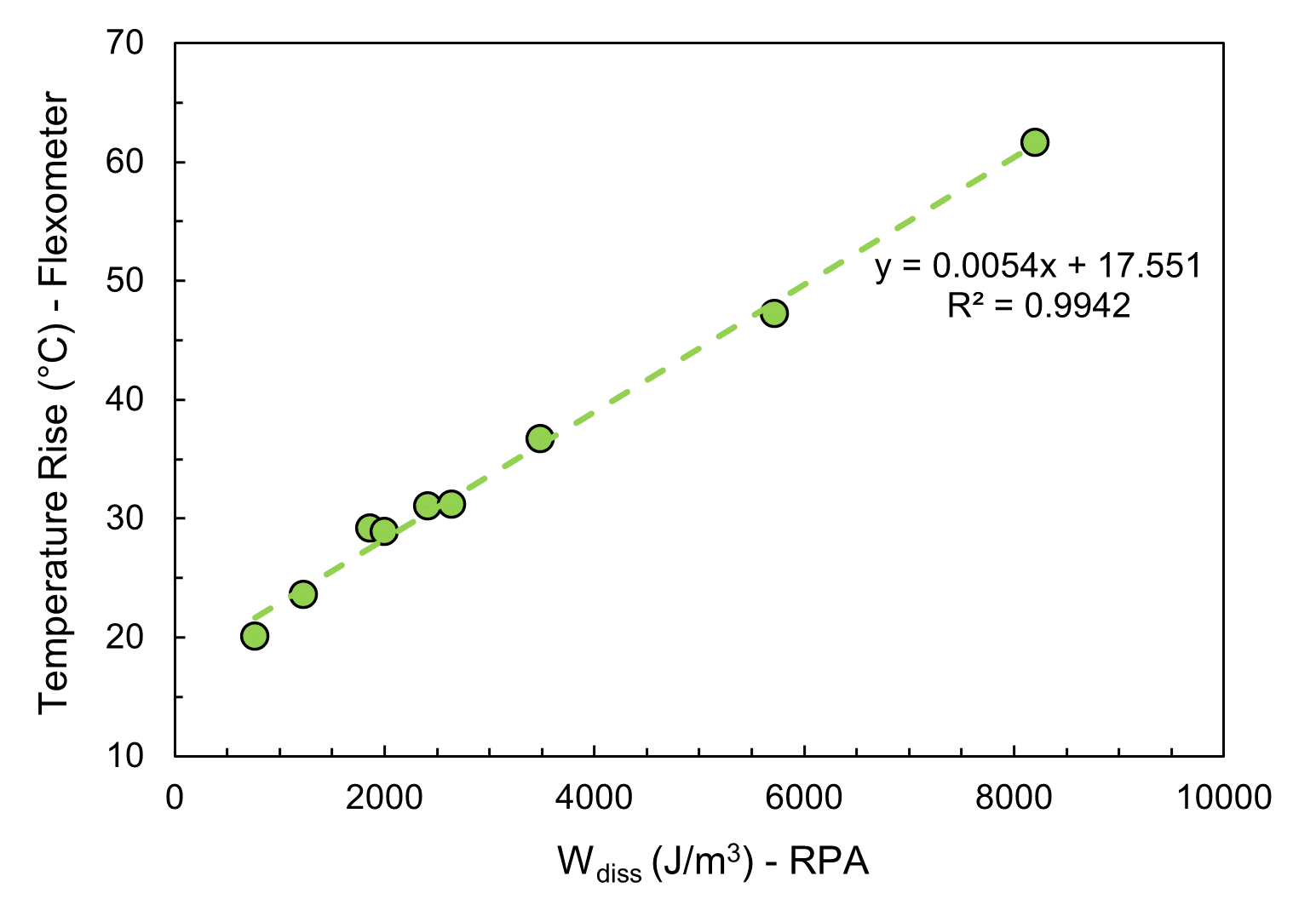
Flexometer temperature rise versus RPA dissipated energy (Wdiss), R² = 0.9942
Solving Real-World Challenges With the Premier RPA
The real-world implications of the RPA’s value as a heat buildup prediction tool are considerable, with possible applications in multiple industries.
Automotive seals and mounts
Achieve better heat resistance without compromising flexibility by optimizing bound rubber content.
Industrial belts and dampers
Minimize thermal degradation in high-load applications by lowering hysteresis loss.
Tires
Moderate bound rubber in the tread could lower rolling resistance without sacrificing wet grip, and limiting heat generation can extend tire life.
Perhaps the greatest potential for bound rubber optimization lies in the tire industry, where sustainability is becoming increasingly important to manufacturers and consumers alike. Understanding bound rubber content may offer deeper insight into the ongoing challenge of striking the appropriate balance between competing parameters. Over time further optimization of these parameters through deeper study of bound rubber content could yield valuable intel.
Making the Most of Bound Rubber
Alpha Technologies published a paper detailing the results of a bound rubber study, with extensive graphics and in-depth data from the Premier RPA.